
Melvor Idle 2 Early Money Making: Compare Net GP per Hour
Compare raw fishing sales, mining and smithing, and thieving in Melvor Idle 2 using a repeatable net GP per hour worksheet.
Which early money-making routes should you compare?
Test fishing surplus, a mining-to-smithing chain, and a Thieving target available to your character. Each gives you a different kind of result, so choose based on what you already have unlocked. A one-time quest payout can fund a purchase quickly, while a repeatable method is what you measure for hourly GP.
| Route | What to measure | Common reason the rate looks too high |
|---|---|---|
| Fishing and selling surplus | Time fishing and the sale value of fish you can spare | Counting fish reserved for Cooking or valuing a rare catch as typical |
| Mining and Smithing | Time to mine, smelt, and make the finished item | Dividing finished sales by smithing time alone |
| Thieving | Direct GP, sellable drops, elapsed time and consumables spent | Ignoring downtime or valuing items you will keep as cash |
| Quest turn-ins | The actual reward and materials handed over | Treating a one-time payout as a repeatable hourly rate |
What do published launch-week comparisons show?
Destructoid published a no-bonus comparison for the first five hours. Dividing its totals by five gives the average for that whole window, including the early progression assumed in the comparison. Use the numbers to pick candidates for your own test, not as a current rate for any individual action.
| Route | Reported GP after 5 hours | Average over those 5 hours |
|---|---|---|
| Mining and Smithing | 74,000 | 14,800 GP/h |
| Thieving | 69,000 | 13,800 GP/h |
| Fishing | 60,000 | 12,000 GP/h |
Destructoid’s launch-week base-profession comparison excludes the bonus setups discussed later in the source. These are third-party comparison figures, not our measurements or guarantees for your character.
How do you measure net GP per hour fairly?
Pick one output you can actually sell. Keep tools, bonuses, and character settings fixed between runs, then write down the real elapsed time instead of assuming the action ran for your whole break. Use the tracker to sanity-check production and the Bank or shop interface to verify sale values.
- Record your game build, skill levels, active tool, and starting inputs. Clear old production from your tally.
- Run a fixed window, such as 15 minutes for a first sample. Record stops and any supplies consumed.
- Count direct gold and only the output you plan to sell. For ingredients taken from your existing stock, subtract what those inputs were worth, or their actual buy price if purchased.
- For a route where you gathered inputs during the test, include the gathering time. Do not also subtract the full sale value of those same inputs unless you are explicitly comparing against the alternative of selling them raw.
- Divide by the elapsed hours. Repeat a sample if one rare item dominates your total.
Worked example, using illustrative numbers: If you sold outputs for 1,200 GP, spent 200 GP on inputs and consumables, and took 20 minutes, the sample works out to 3,000 net GP per hour. These are example numbers, not an observed in-game rate.
How do you decide whether smelting is worth the time?
Compare two routes starting with the same batch of ore. In the first, sell the ore and use the time you saved on your best unlocked activity. In the second, smelt the ore and sell the bars. Choose the route with the higher total GP over the same amount of time. Early Access copper prices and uses
For example, if a batch could sell for 240 GP raw or 360 GP as bars, smelting adds 120 GP. If it takes two extra minutes, that processing step adds 3,600 GP/h on its own. If another available activity reliably earns more during those two minutes, selling raw can still leave you with more GP. These figures illustrate the comparison. Use your Bank’s current prices.
What should you sell, and what should you keep?
Reserve the exact amount needed for your next known recipe or quest. A pile of raw fish can be converted to food for a combat goal, and bars may be required for gear or a tool purchase. Treat only the excess as sellable stock unless you deliberately choose to postpone that next objective.
The developer’s launch notes increased some early sale prices and Slayer payouts and lowered feather prices. Older demo rankings can point you toward actions to test, but use your own live rates to choose. A lower theoretical rate can be the better first action if it needs no inputs and runs reliably while you are away.
- Use Pointy Preparation for your first quest payout
- Plan an ore-to-gear production chain
- Decide which fish to reserve for food
Which money-making route should you try next?
| What you have available | Route to try |
|---|---|
| Lowtown District and a spare food stack | Thieving GP route |
| Fishing unlocked and an upcoming offline session | Fishing for GP |
| Crafting 18 and spare silver or Topaz | Silver Topaz jewelry |
| A tested combat loadout and spare supplies | Combat GP farming |
References
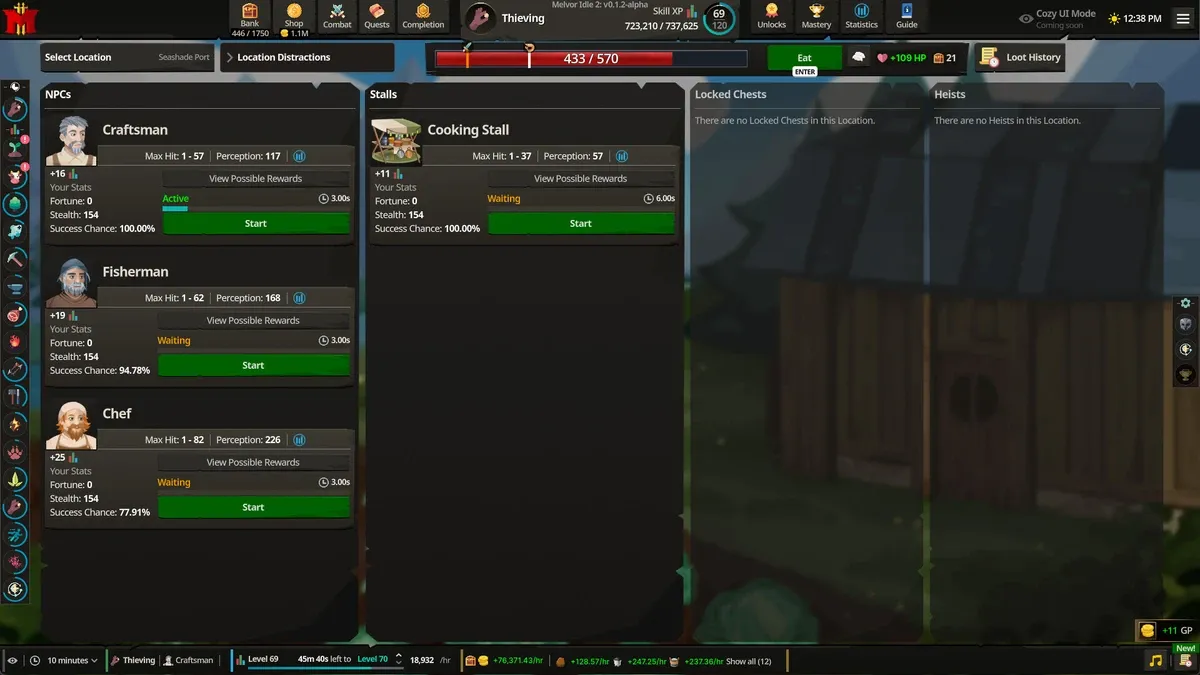
Official tracker and game feature overview · Official Early Access sale-price and GP changes The cover is the official Thieving screen, one of the three comparison routes.
Related Articles
combat
Melvor Idle 2 Quick-Equip Guide: Weapons and Loadouts
Find missing weapons in Melvor Idle 2’s Quick-Equip menu, filter by combat style, and use Tab to compare equipment against different loadouts.
combat
Melvor Idle 2 Idle Combat Guide: Check Auto-Eat and Enemy Damage
Check Auto-Eat, enemy damage, special attacks, and supplies before committing to unattended combat in Melvor Idle 2.
dungeons
Melvor Idle 2 Hobgolbin Camp: First Dungeon Walkthrough
Unlock Hobgolbin Camp in Melvor Idle 2, follow all four waves, and prepare enough food and gear for a supervised first clear.
Was this helpful?
Thanks for the feedback!